





EPISODES
Children flourish through encounters with people and cultures, gradually unfolding their worlds through the relationships they build.
As these connections extend beyond their immediate communities, their learning deepens and expands.
Here, we share HIROGARI—stories of learning that grow through connection.
The foundation that supports children's development
Children grow through their own agency
and in how they influence
one another.
#Empowerment
Children Who Welcome and Support One Another
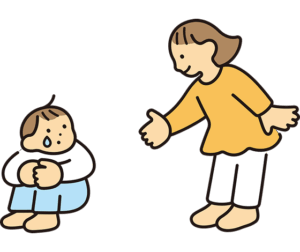
On the nursery floor where children aged 0 to 2 spend their days together, new children often join the community.
In these moments, we see the existing children begin to act on their own initiative.
Without being instructed, they quietly observe the newcomers, sensing when support is needed, and gently reaching out.
In these actions, we see children beginning to experience their own agency— to understand what they can offer to others, and to develop a desire to support and empower one another.
At the same time, when a new child is trying to do something independently, they sometimes choose to step back and simply watch— respecting the other’s effort to try.
Children move from being protected and cared for to becoming active participants in their environment, capable of influencing situations and encouraging others.
We believe it is essential that children develop trust in their own abilities and the confidence to take meaningful steps forward in their lives.
Development is holistic—
multidimensional
and integrated.
#Holistic Development
Weaving Ideas and Wisdom:
Building a Scarecrow
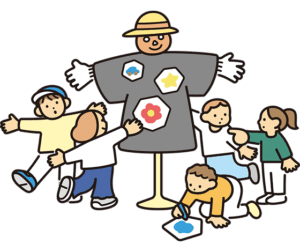
As part of a local scarecrow competition, children engage in a shared creative process.
During the preparation, they express their ideas and listen to one another, gradually shaping a shared vision.
Through dialogue, they learn to appreciate different perspectives and work collaboratively toward creating something meaningful together.
In this process, development is not limited to cognitive thinking.
It also involves the passion to express oneself and the capacity to empathize and relate to others.
These dimensions—intellectual, emotional, and relational— are nurtured as one integrated experience.
When selecting materials, children explore through touch, weight, and form, engaging in repeated trial and reflection. The sensory experience in their hands and the desire to create are inseparable, becoming deeply embedded within their learning.
The scarecrow they create together is not simply a finished object. It is a reflection of their thinking, their feelings, and their embodied engagement— a living expression of their growing capabilities. Within children’s everyday experiences, learning is always present, embedded in life itself.
Connections extend beyond
the classroom into the
community
#Family and Community
Belonging, contributing, and
growing with a sense of security as part of the community.
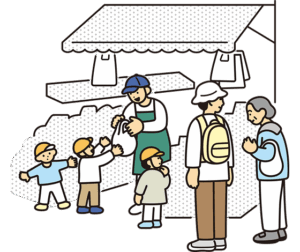
The local greengrocer is not just a place to shop for the children. It is a place where they are naturally welcomed as part of everyday life.
Their interactions with the shop owner go beyond a relationship of teaching and learning; they reflect a warm, lived sense of coexistence within the community. Through simple conversations about fruits, children begin to realize: “There are people in our community who care about us,” “There are people here we can talk with,” “There are people who know so much.” These everyday moments nurture a deep sense of belonging— a feeling that they are valued members of their own community.
Through relationships with people in the neighborhood, children gradually develop a sense that “wherever I go, I am accepted,” and that they are part of a shared life. Beyond the walls of the childcare setting, they come to see themselves as meaningful participants in the wider world. It is this sense of belonging that gives children the confidence to take on new challenges.
Living together across home, school, and community— we believe this inseparable web of relationships becomes the foundation of a child’s life.
Children grow through relationships—
with nature, with people, and with
the cycles of life.
#Relationships
A Story of Life Woven with a
Swallowtail Butterfly
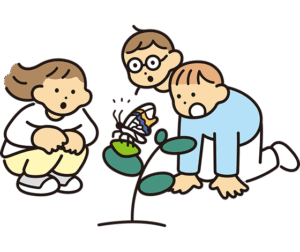
Throughout the seasons, children return to the same park, forming deep connections with the natural world.
One year, they welcomed a swallowtail caterpillar into their classroom. Through daily care—cleaning its space, speaking gently, and observing its small changes—they experienced the wonder of life up close. This encounter was not separate from their everyday lives. It connected to what they eat, how they live, and how life continues in cycles all around them. From nature to the table, from the park to the community, children begin to understand that they are part of a larger living world.
When the butterfly finally emerged, a quiet stillness filled the room— a shared moment of awe and respect for life.
We believe children do not grow in isolation. They grow through relationships— with nature, with others, and within the cycles that sustain life. These experiences gently nurture their hearts, helping them grow as part of a connected and caring community.
The image of children unfolding from the foundation
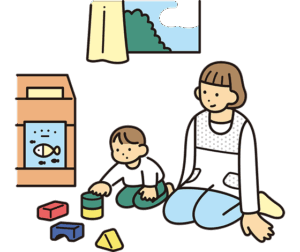
Children maintain their Well-Being when they feel safe, valued, and needed.
#Well-Being
A Morning When Tears
Turned into a Step Toward the World
A two-year-old arrives at the nursery for the first time. As their parent leaves, tears begin to fall. They are gently held and given space to settle. Gradually, the tears fade and their breathing softens.
Then, they reach out toward a set of blocks nearby, stacking them one by one. In that moment, the child begins to move from being comforted to engaging with the world.
When children feel safe, and know they are accepted and valued, they regain the strength to turn outward again and take their own next step.
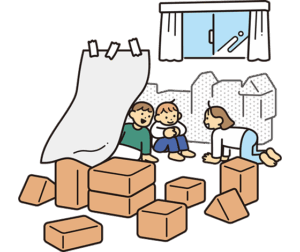
Children grow when they feel a true sense of belonging—
when they are accepted, valued, and able to be themselves.
#Belonging
A Place We Built Together,
Surrounded by Blocks
During morning play, children spend time in spaces they feel comfortable in. One child begins by bringing wooden blocks and placing them on the floor. Another joins, saying, “Let’s build it over here.” Soon, more children gather, each adding their own ideas.
“This can be the kitchen.” “This is the baby’s bed.” Little by little, a shared space begins to take shape. The children sit within the space they have created, naturally coming together. The surrounding sounds soften, and what was once part of the room becomes a world of their own.
In this moment, the space is no longer just physical — it becomes a place where they feel they belong. When children feel safe, and create spaces together with others, they begin to build a sense of belonging that supports them as they grow. Within that sense of belonging, they expand their worlds and grow with confidence.
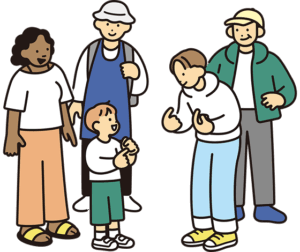
Every child deserves to be respected and valued.
Each child also has the power to make a positive difference in their community through their own actions.
#Contribution
Connecting Through Sign Language:
What Truly Matters to Us
The regular “Sign Language Time” sessions
are about much more than learning a new way of communicating.
They are an opportunity for children to experience the joy of connecting with diverse people and to realize that they, too, can help others feel included and connected.
Children encounter people who communicate in ways that differ from their own and begin to ask themselves, “How can we understand one another?”
Through learning sign language, they come to understand an important truth:
spoken language alone cannot connect everyone.
They also discover that by expanding the ways they express themselves, they can connect with more people and help create spaces where everyone feels a sense of belonging.
At the heart of this is a simple and genuine feeling: “Even if we do not share the same language, I want to know you.” “I want to connect with you.”
Through these experiences, children learn that
everyone is equal and that every person is an essential part of the community.
Learning sign language is not simply about acquiring a new skill.
It is about realizing: “I can help create places where others feel safe.”
“I can support this community so that everyone can participate.”
By discovering this, children begin to understand that their own actions can gradually change a community for the better.
This belief— “I have the power to make a difference” — is where true contribution begins.
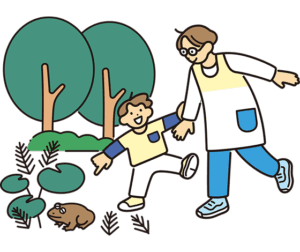
Listening to Children’s Voices, Sharing Meaning Together
#Communication
A Moment of Shared Understanding Through
Gesture and Gaze
“Look! I want to show you!” A child runs across the playground toward a teacher. Unable to fully express their excitement in words, they gesture eagerly, using their whole body to communicate.
They point toward a large grasshopper. The teacher responds, saying, “You found something!” Together, they observe it closely as it begins to move. Soon, other children gather, drawn by the moment. One child’s discovery becomes a shared experience, spreading into a rich moment of connection.
Children do not communicate through words alone. They express, receive, and respond through gesture, movement, and presence. What matters is the desire to share— the feeling of “I want you to see this.” When that feeling is received, communication becomes connection.
Children explore the world by asking
questions, forming their own ideas, and testing them through experience.
#Exploration
A Small Universe Inside a
Bucket
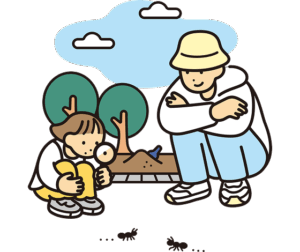
Children visit a nearby nature observation park. It is a place where small living creatures gather and where their curiosity is welcomed. “What is this?” “Why does it move like that?” Their questions are received with care, and rather than being given answers, they are encouraged to observe, think, and try. Children collect insects, create simple habitats, and continue to care for them.
Through this process, they form their own ideas, test them, and gradually deepen their understanding. Exploration is not about finding the right answer. It is about asking questions, wondering, and staying with the unknown. With the support of knowledgeable guides, children are given the time and space to follow their curiosity.
Over time, their persistence grows. What begins as a simple question becomes a journey— a journey of sustained engagement with the world around them.